
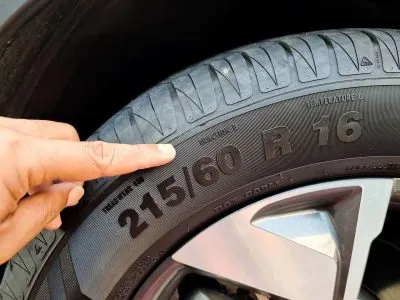
How to Read Tyre Sidewall Markings: A Beginner’s Guide
Look closely at the side of any tyre and you’ll find a string of numbers and letters that looks more like a password than useful information — something like 215/65R16 98H. Most drivers ignore it completely, until they need to replace a tyre and aren’t sure whether what they’re being offered actually matches what’s already on the car.
The good news is that every part of that code means something specific, and once you know how to read it, buying the right tyre becomes far less confusing. Here’s a plain-language breakdown — and once you’re comfortable with the basics, it also makes it much easier to know when your tyres are actually worn out rather than just guessing.
Breaking Down a Tyre Size: 215/65R16 98H
Let’s use that example and go through it piece by piece.
215 — Section Width (in millimetres)
This is the width of the tyre from sidewall to sidewall, measured in millimetres, when mounted and inflated. A tyre marked 215 is 215mm wide. Wider tyres generally offer more grip and a larger road contact area, but can affect fuel efficiency and are more sensitive to wheel arch clearance.
65 — Aspect Ratio
This is the height of the tyre’s sidewall, expressed as a percentage of the section width. A rating of 65 means the sidewall height is 65% of 215mm — roughly 140mm. Lower aspect ratios (like 45 or 50) mean a shorter, stiffer sidewall, often seen on sportier vehicles for sharper handling. Higher aspect ratios mean a taller sidewall, which usually gives a more cushioned ride and better protection against pothole damage — a genuine advantage on many Kampala roads.
R — Construction Type
R stands for radial construction, which is standard on virtually all modern passenger and commercial tyres. The internal cords run radially across the tyre, giving better flexibility, heat dispersion, and durability compared to older bias-ply designs.
16 — Rim Diameter (in inches)
This tells you the diameter of the wheel the tyre is designed to fit, measured in inches. A tyre marked 16 fits a 16-inch rim. This number must match your wheel exactly — there’s no flexibility here.
98 — Load Index
This number refers to a standardised chart that tells you the maximum weight a single tyre can safely carry when properly inflated. It’s not the weight itself — it’s a code. For example, a load index of 98 corresponds to a maximum load of 750kg per tyre. Always check your vehicle’s recommended load index (usually found on a sticker inside the driver’s door or in the owner’s manual) before choosing a replacement, especially for vehicles that regularly carry heavy loads or extra passengers. This matters even more for commercial vehicles — see our guide on choosing the right truck tyres for heavy loads for a closer look.
H — Speed Rating
This letter indicates the maximum speed the tyre is rated to sustain safely under its recommended load. Common ratings include:
| Speed Rating | Maximum Speed |
|---|---|
| Q | 160 km/h |
| S | 180 km/h |
| T | 190 km/h |
| H | 210 km/h |
| V | 240 km/h |
Fitting a tyre with a lower speed rating than your vehicle’s manufacturer specification isn’t just a performance limitation — it can affect handling stability and isn’t recommended, even if the tyre size matches. A mismatched or unbalanced tyre can also masquerade as a wheel alignment problem, so it’s worth ruling both out during a service visit.
Other Important Markings on the Sidewall
DOT Code — Manufacture Date
Near the tyre size, you’ll usually find a code ending in four digits, such as 2224. This tells you the tyre’s manufacture date: the first two digits are the week, and the last two are the year. So “2224” means the tyre was made in the 22nd week of 2024. This matters because rubber ages even if a tyre has never been driven on — always check this on any tyre you’re buying, including on a “new” tyre that may have sat in storage. If you’re shopping on a budget, our post on where to find cheap tyres in Kampala without compromising safety covers exactly this kind of pitfall.
Load and Inflation Details
Some tyres also display maximum load and maximum inflation pressure directly on the sidewall. This is a manufacturer safety limit, not necessarily the pressure you should run day-to-day — for correct daily tyre pressure, always check your vehicle’s own specification (usually on the driver’s door sticker), not the tyre’s maximum rating.
M+S or 3PMSF Symbols
M+S (Mud and Snow) or the 3-Peak Mountain Snowflake symbol indicate a tyre designed for mixed or winter conditions in colder markets. These aren’t especially relevant for most driving in Uganda, but you may see them on imported tyres and it’s useful to know they don’t indicate anything about local road suitability.
E-Mark or DOT Approval
A small circled “E” followed by a number, or a “DOT” stamp, indicates the tyre meets European or US safety and quality standards respectively. It’s a useful reassurance when comparing tyres from unfamiliar brands.
Why This Matters When Buying Tyres in Kampala
Understanding sidewall markings protects you in a few practical ways:
- You can confirm you’re getting the correct size for your vehicle, rather than relying entirely on a seller’s word
- You can check how old a tyre actually is, even a “new” one, since tyres can sit in storage for years before sale
- You can make sure the load index and speed rating match or exceed your vehicle’s requirements, particularly important for anyone carrying heavy loads or driving at highway speed
- You can compare tyres more confidently across different brands and price points, since the size code is standardised industry-wide
A Quick Reference Before You Buy
Next time you’re shopping for tyres, bring this checklist:
- Confirm the size matches your current tyres or your vehicle’s manufacturer specification
- Check the load index meets or exceeds what your vehicle needs
- Check the speed rating meets or exceeds your vehicle’s manufacturer specification
- Check the DOT code — aim for tyres manufactured within the last 1–2 years where possible
- Ask the seller to explain anything on the sidewall you’re unsure about
How Tyre Express Uganda Can Help
You don’t need to decode a sidewall on your own. At Tyre Express, our team will confirm the correct size, load index, and speed rating for your specific vehicle before recommending any tyre, and we’re happy to walk you through exactly what you’re looking at on any tyre in our showroom. We stock a wide range of sizes across Dunlop, Falken, CEAT, Triangle, and Alliance — browse our full tyre brands range or our tyres for cars, 4x4s, trucks and buses page for cars, SUVs, vans, trucks, and buses.
Visit us at our Jinja Road head office, Dunlop Zone (Moil Fuel Station, Banda), or our Bombo Road branch in Wandegeya — or request a quote online with your current tyre size and we’ll confirm the right options for you.
Frequently Asked Questions
Where exactly on the tyre do I find these markings?
They’re moulded directly into the rubber on the sidewall — the outer face of the tyre, visible without removing the wheel. If it’s hard to read, check the sidewall facing away from the car, as the outer side is usually kept cleaner and more legible than the inner side.
Can I fit a different tyre size than what came with my car?
It’s possible in some cases, but it should only be done with guidance from a technician. Changing size can affect speedometer accuracy, ground clearance, and how your tyres interact with your vehicle’s suspension and braking systems. Always check with a professional before deviating from the manufacturer’s recommended size.
What does it mean if two tyres have the same size but different load index numbers?
It means they’re rated to carry different maximum weights, even though they’re physically the same size. This can happen between different lines from the same brand, or between brands. Always match or exceed your vehicle’s required load index, not just the size.
Is a higher speed rating always better?
Not necessarily “better,” but it should always meet or exceed your vehicle manufacturer’s specification. Higher speed-rated tyres often have stiffer sidewalls tuned for high-speed stability, which isn’t always the most comfortable choice for everyday city driving. The priority is meeting your vehicle’s minimum requirement, not simply choosing the highest number available.
How can I tell if a tyre being sold as “new” is actually old stock?
Check the DOT code on the sidewall. Even an unused tyre ages once manufactured, so a “new” tyre made five or six years ago is not the same as one made in the past year. A reputable seller should be able to show you this code and explain it without hesitation.
Do these markings apply to truck and bus tyres too?
The same basic system — width, aspect ratio, construction, rim diameter, load index, and speed rating — applies across passenger, SUV, van, truck, and bus tyres, though commercial tyres often carry additional load range markings specific to heavier vehicles. Our team can explain these in detail for any commercial vehicle.